
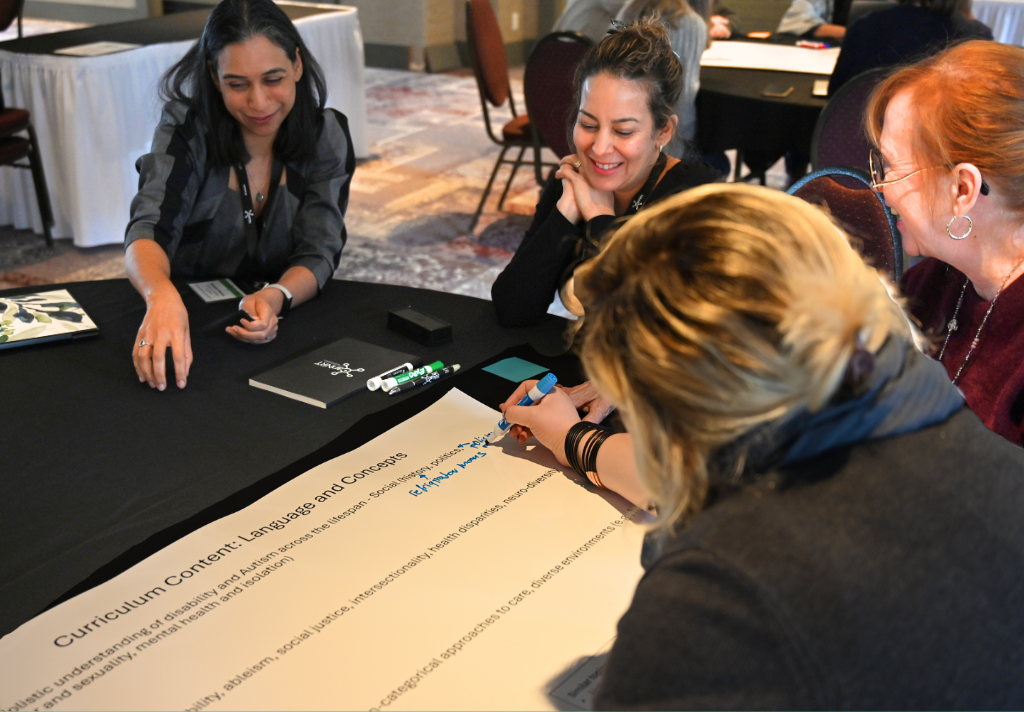
What does it take to build a curriculum that reflects the realities of neurodevelopmental research?
This work, led by the CanNRT Curriculum Co-Design Committee, co-chaired by Michelle Phoenix (McMaster University) and Noémie Cusson (Université du Québec à Montréal), brought together a national group of trainees, researchers, clinicians, community partners, and people with lived and living experience in a multi-year process grounded in dialogue, reflection, and validation with a wide range of participants.
Rather than defining training priorities in isolation, the committee created space for a wide range of perspectives to shape both what is taught and how learning happens.
Co-Design in Action. This video brings together reflections from members of the Curriculum Co-Design Committee and participants. It offers a look at how co-design unfolded in practice, why it matters to those involved, and what it takes to build training through shared responsibility, trust, and collaboration. (Production: Noah Leon, 2025)
A process shaped by participation
Over several years, the committee facilitated interviews, focus groups, and national share-back sessions to gather perspectives from across the neurodevelopmental research ecosystem.
Participants reflected on how research training currently works and where it falls short. Many pointed to gaps in community engagement, research ethics, and the integration of lived and living experience.
As one participant noted, without these perspectives, research risks reproducing the same limitations it aims to address.
These conversations helped guide the committee’s work and informed the recommendations that followed.
What emerged
Through this process, several themes emerged as essential to integrate into training for the next generation, alongside core research skills that remain central to most programs. These include critical reflexivity and self-awareness, such as understanding one’s positionality, biases, and the broader social and historical contexts shaping research. Community engagement also emerged as a key area, highlighting the importance of building reciprocal relationships, recognizing different forms of knowledge, and connecting beyond academic settings. Research skills were reframed to include methodological training, and also the ability to communicate research across audiences and work collaboratively across disciplines.
Participants also co-developed shared value statements that emphasize inclusion, openness, accessibility, cultural humility, and accountability as central to training.
Just as importantly, the process underscored that how training happens matters as much as what is taught. Participants highlighted the importance of participatory and experiential learning approaches that create space for dialogue, reflection, and collaboration.
Why this work matters
Co-design offers the opportunity to rethink how training in neurodevelopmental research can be built through partnership. It does not resolve every tension, nor does it eliminate structural constraints. But it does make it possible to build training that is more honest, more inclusive, and more accountable to the people it serves.
Learn more
Explore the co-design process in this poster presentation shared at the 2026 INSAR Annual Meeting by Noémie Cusson, CanNRT alumna, Steering Committee Member, and Curriculum Co-Design Committee Trainee Co-Chair. It outlines the stages of engagement, key themes, and how community input shaped the curriculum.