

Overview
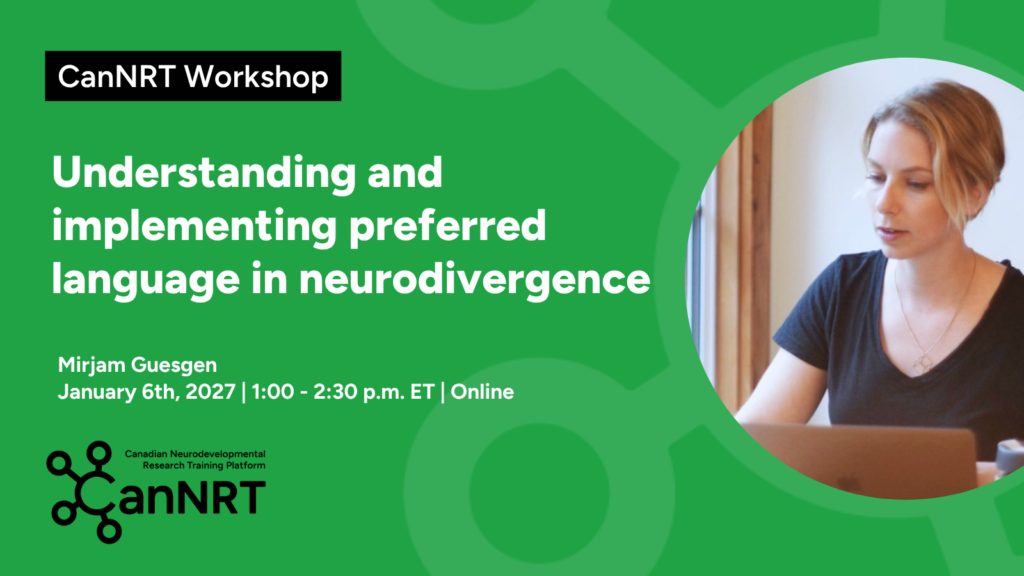
Speaker: Mirjam Guesgen
Date: January 6, 2027
Time: 1:00 – 2:30 p.m. ET
Language: English
Format: Online (via Zoom)
Audience: CanNRT Fellows and Trainee Members
Registration & Attendance Commitment
CanNRT workshops are offered free of charge, but registration is required. Each session represents an investment in expert-led training, co-designed curriculum, time, and resources.
By registering, you are committing to attend. If your plans change, please let us know as early as possible so we can offer your place to another trainee.
As a member of the CanNRT community, you work closely with neurodivergent people when researching neurodevelopmental conditions, and will encounter many scenarios where you will write about neurodivergence. The goal of this workshop is to share evidence- and experience-based guidelines on the preferred language for conditions including ADHD, Down Syndrome, Tourette syndrome and dyslexia (some information will also be provided about language in autism). You will also have the opportunity to practice implementing those guidelines to rewrite texts that you may encounter in your work/research.
The workshop will give you a deeper understanding of a neurodivergent person’s experience, and demonstrate how language can either cause people to feel alienated or pathologized or respect and empower them. Rather than cut and dry guidelines, this workshop highlights the evolving nature of language. It was co-developed with neurodivergent people.
Learning Objectives
By the end of the workshop, participants will:
- Understand neurodivergent people’s experiences, and demonstrate how language can be both empowering or lead to feeling alienated.
- Have evidence- and experience-based guidelines for preferred language for various neurodevelopmental conditions.
- Implement these guidelines for texts that you may encounter in your work/research.
Workflow and Outcomes
During the workshop:
- Analyze, critique and rewrite texts in accordance with the suggested guidelines presented.
Handouts and Readings
- Slides from the workshop
- Workshop activity guide
Other Details
The workshops will be held online using Zoom. Participants will receive a reminder with the link close to the workshop date.
You will be using the workbook during the workshop so please make sure it is available to you. You may write in it digitally or print it out before the workshop.
As well as your laptop or computer, feel free to have paper, pens and pencils on hand for noting down your thoughts or doing initial planning.
Be ready to discuss, share ideas and participate actively!
Speaker
Dr. Mirjam Guesgen is an award-winning journalist, writing for outlets in Canada, the US and abroad. She also writes scripts for popular YouTube channels like SciShow, where her videos reach an audience of more than 8 million. As part of the McGill Writing Centre, she teaches written communication skills through workshops like this and the WCOM314 Communicating Science class. Before becoming a journalist full-time, she completed her PhD in Zoology at Massey University in New Zealand and a postdoctoral fellowship at the University of Alberta. Her forthcoming book, The Rise and Fall of the Lab Rat, will be published in 2028.