

Overview
Speaker(s): Mehdi Ghanadzade
Moderator: Keiko Shikako
Date: Monday, November 3, 2025
Time: 5:00 to 6:00 p.m. ET
Language: English
Format: Online, via Zoom
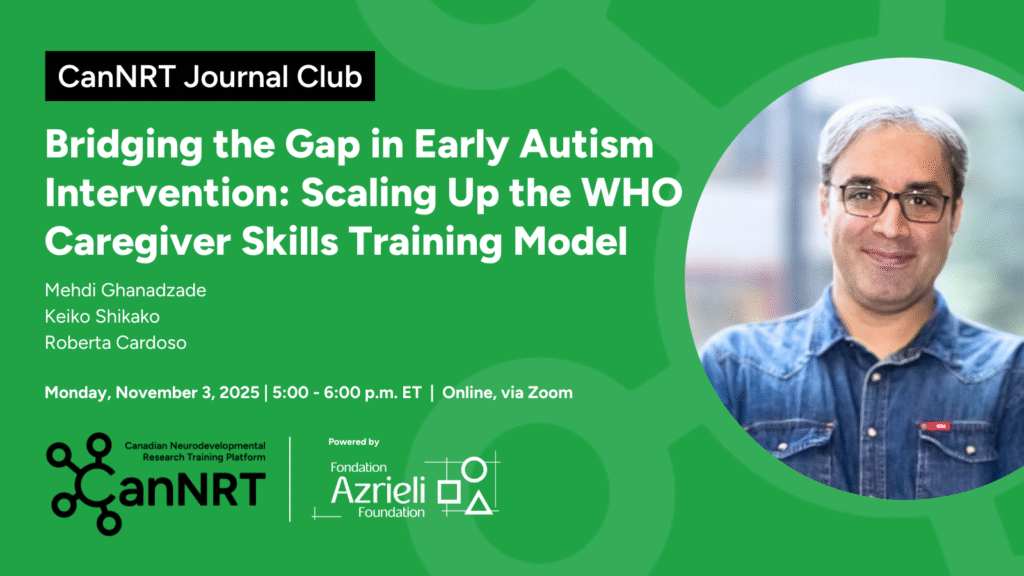
Join us for a monthly trainee-led Journal Club exploring how research can inform real-world practice and public policy. This session focuses on implementation fidelity—how closely early intervention programs are delivered as intended—and what that means for scaling up the World Health Organization’s Caregiver Skills Training (CST) model for autistic children.
Through discussion and peer learning, participants will examine how fidelity influences program outcomes, sustainability, and equitable access across diverse communities.
Learning objectives
- Understand implementation fidelity in early intervention programs: Define the core components of implementation fidelity and examine how fidelity affects outcomes for children on the autism spectrum and the broader reach of early intervention models like WHO CST.
- Examine barriers and facilitators that shape fidelity: Identify individual, organizational, and systemic factors that impact fidelity—from practitioner skills and family engagement to leadership, funding, and policy contexts.
- Develop strategies to strengthen fidelity in practice and policy: Learn practical, evidence-informed ways to assess, monitor, and improve implementation fidelity within real-world early intervention systems, with attention to equity, inclusion, and contextual adaptation.
About CanNRT Journal Club
The Journal Club is a collaborative learning activity designed to foster critical thinking, enhance scientific communication, and promote knowledge sharing among peers. Through engaging discussions, participants explore diverse perspectives and deepen their understanding of recent evidence and its relevance to their work.
Questions?
Contact:
Roberta Cardoso
Priority Area Leads (PALs) Coordinator, CanNRT
roberta.cardoso@muhc.mcgill.ca
Ellie-Anna Minogianis
Training Program Manager, CanNRT
ellie-anna.minogianis@mcgill.ca