
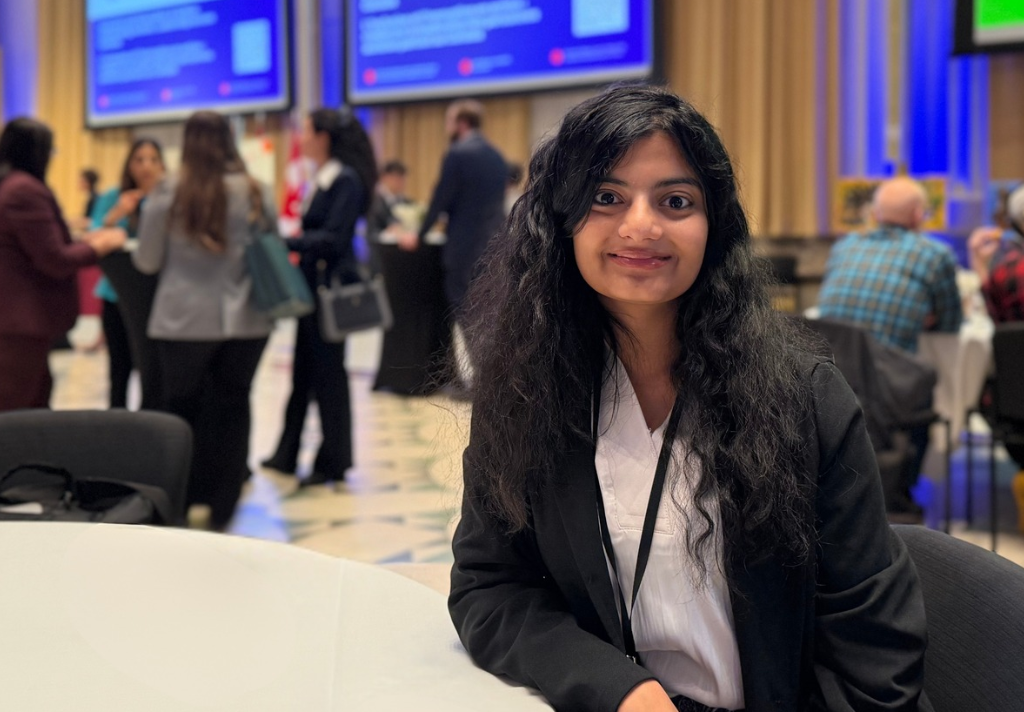
At 16, Toshani Sharma is a youth advocate for neurodevelopmental inclusion, an author and an emerging researcher. At 14, she founded HOPE, a youth-led initiative that brings together education, research and community perspectives to challenge misconceptions about neurological and neurodevelopmental conditions.
Through HOPE, she has developed educational resources, engaged young people in conversations about autism and connected with researchers and people with living and lived experience. Her published research on social compensation and autistic burnout in adolescent girls reflects her interest in experiences that may be overlooked.
As a CanNRT Community Member, Toshani shares what motivates her work and her message to emerging researchers and professionals in neurodevelopment.
What motivates your advocacy and community work?
I have always found it interesting how much we talk about inclusion, yet how little we sometimes understand the people we are trying to include.
When I first began exploring autism and other neurological conditions, I realized that so many of the challenges individuals face do not come from their conditions alone, but from the misconceptions, assumptions, and barriers surrounding them.
Today, what motivates me most is the possibility of changing someone’s perspective. If a student walks away from one of our workshops questioning a stereotype they previously believed, I consider that meaningful progress.
I believe that awareness is where inclusion begins, but understanding is what makes it last.
What have you learned through the HOPE Initiative?
One thing I would love people to know about HOPE is that it was never intended to be just an awareness campaign. I wanted it to become a space where education, research, and community experiences could come together.
Perhaps the biggest lesson I have learned is that advocacy is not about having all the answers. It is about being willing to listen, question your assumptions, and recognize that the people most affected by an issue should have a meaningful role in shaping the solutions.
What message would you share with emerging researchers and clinicians?
If there is one message I would share, it is this: Please remember that behind every diagnosis, research finding, or clinical assessment is a person whose experiences cannot always be captured by a checklist or a statistic.
Someone may appear to be coping well from the outside while experiencing significant challenges that remain unnoticed. This made me question how often our understanding of neurodevelopment depends on what we can observe rather than what individuals themselves are experiencing.
I hope we move toward a future where neurodevelopmental research is not simply focused on identifying differences, but also on understanding how individuals can thrive in environments that recognize and accommodate those differences.
Beyond studying neurodevelopmental conditions, we need to involve individuals with living and lived experiences in identifying research priorities, designing studies, and interpreting findings.
Most importantly, I hope the next generation of researchers approaches neurodevelopment with curiosity, humility, and a willingness to listen.
What would you say to other young people interested in research or advocacy?
I think one of the most encouraging things I have learned through HOPE is that you do not need to wait until you have a degree, a professional title, or years of experience to contribute meaningfully to a conversation.
I started HOPE as a student with questions, curiosity, and a desire to make information more accessible. Along the way, I have learned from researchers, advocates, educators, volunteers, and individuals with lived experiences who have challenged me to think differently.
I am still learning, and I hope that never changes.
Collaborate and connect
Toshani welcomes opportunities to connect with researchers, trainees and community organizations interested in neurodevelopmental inclusion, accessible science communication and youth engagement.
Connect with Toshani on LinkedIn, explore HOPE’s Substack or listen to the HOPE podcast.