
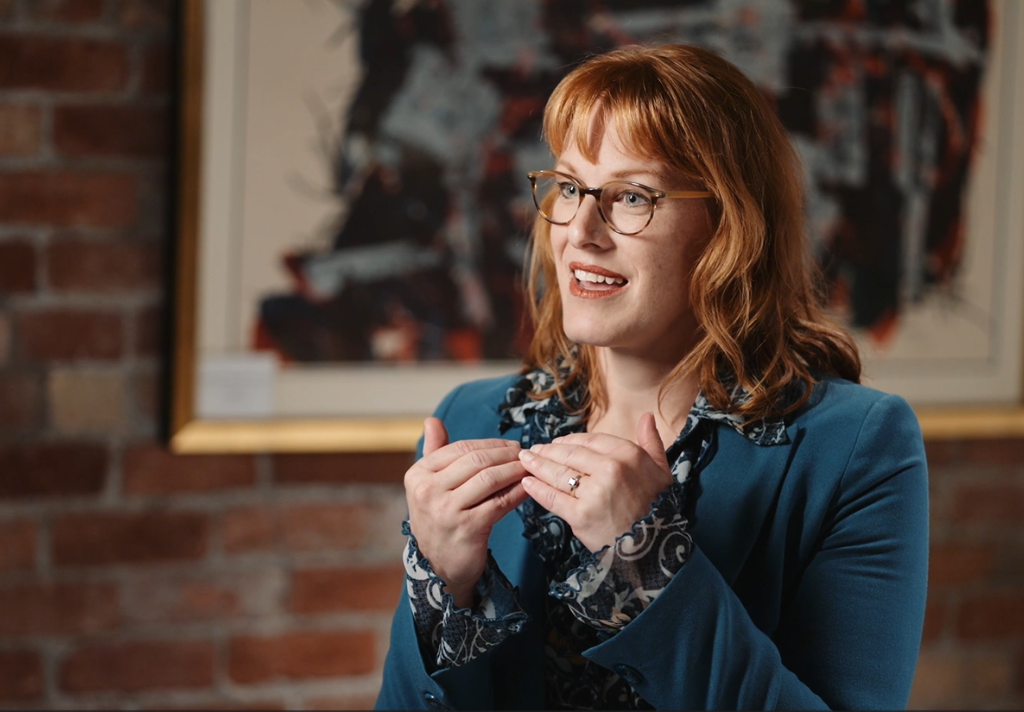
Professor Myriam Beauchamp’s research challenges misconceptions about bilingualism and neurodevelopmental conditions while advancing more equitable, culturally responsive care for children and families from minority-language backgrounds through community-informed research and clinical practice.
Myriam L. H. Beauchamp, PhD, is an Assistant Professor in the School of Rehabilitation Sciences at the University of Ottawa, where she leads a research program focused on bilingual language development and equitable access to services for individuals with neurodevelopmental conditions. Trained as a speech-language pathologist, her work bridges clinical practice and research to better support children and families from minority-language backgrounds.
A former Quebec Autism Research Training (QART) Fellow—CanNRT’s predecessor program—Professor Beauchamp now contributes as a CanNRT Faculty Member, embracing the opportunity to mentor trainees and give back to a community that helped shape her own path. Through her research and community partnerships, she is advancing more inclusive approaches to care while empowering families and clinicians with evidence-based guidance.
Why is equity such a central focus of your research and community partnerships?
Beauchamp: Equity is the primary motivation behind my work. I also strongly believe in working closely with the communities we serve, because their expertise and lived experience are central to the research we do in my lab.
Families have really guided my work. Their questions and experiences have shaped both the research I pursue and the values I carry as a researcher. I’ve learned so much from the families I’ve worked with, and I’m very grateful that they’ve trusted me with their experiences.
Myriam reflects on the importance of supporting access to minority languages for children with neurodevelopmental conditions, and on how families continue to inspire and guide her work at the 2025 Annual CanNRT Summer School (Production: Desmond Dyson).
What gaps or misconceptions is your research helping to address, and how is your research helping to improve supports and services for bilingual children and families?
Beauchamp: My work examines bilingual language development in the context of neurodevelopmental conditions. Historically, many parents who spoke a minority language were told not to use that language with their child because it was believed to negatively affect development. Research from my lab and others has shown that these recommendations are not evidence-based.
We are now working to better understand both the similarities and differences between bilingual and monolingual development, as well as the factors that influence language outcomes. This can help clinicians better assess and support bilingual children and their families.
My research also examines barriers to equitable services for families from minority-language backgrounds. We know that healthcare outcomes are often poorer for minority-language speakers because of barriers in access to care. When neurodevelopmental conditions are part of that picture as well, families can experience multiple layers of vulnerability. I think we need to become better, as clinicians, researchers, and systems, at adapting the way we work and thinking more seriously about equity rather than simply treating everyone the same way.
What has your experience with CanNRT meant to you, first as a Fellow and now as Faculty?
Beauchamp: I joined the CanNRT Summer School Faculty in 2025, and I really enjoyed teaching and interacting with the next generation of researchers. I love that CanNRT gives trainees opportunities to learn outside their own area of expertise and connect with people from different disciplines.
I’ve always believed in “passing it forward.” We all have a responsibility, as researchers and clinicians, to help support the next generation.
What advice would you give trainees about working across disciplines and building strong collaborations?
Beauchamp: I would encourage fellows to take advantage of opportunities to learn outside their own field and to build connections across disciplines.
One thing I’ve learned is to know both what you know and what you don’t know. Recognizing the limits of your own expertise, and seeking out people with complementary knowledge, makes you a better clinician, researcher, and colleague.
Stay in touch
Connect with Professor Beauchamp and learn more about her work via her UOttawa profile.